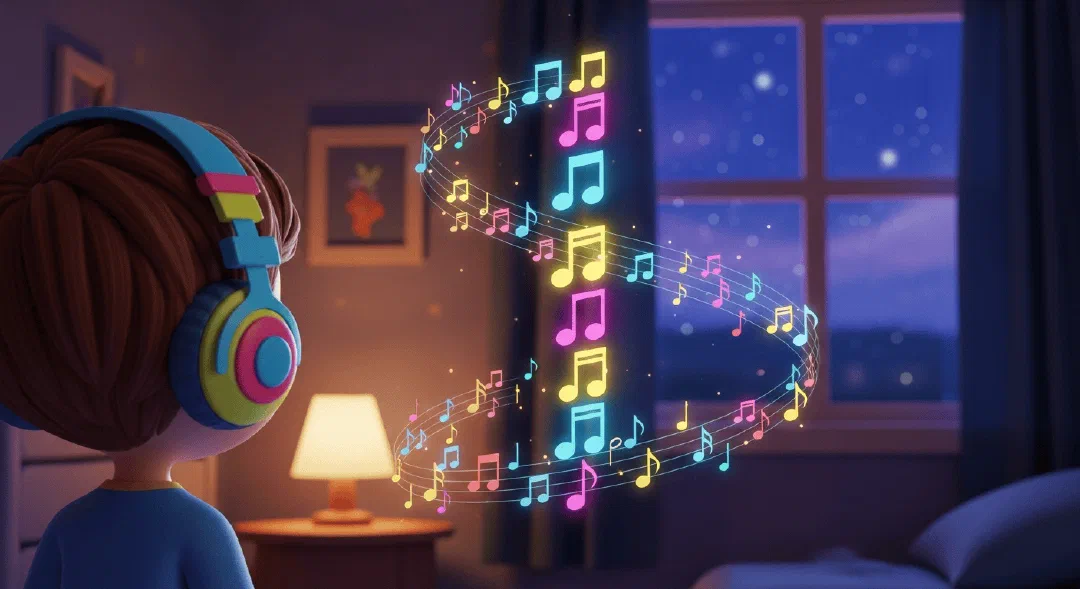
Spotify has over 100 million songs. How do you ever find the one song that’s perfect for you? Spotify came up with a clever answer.
A Small Problem in a Sea of Songs
Imagine walking into a gigantic library with 100 million books.
Wow, it has everything! But… where do you even start reading?
That’s the exact problem Spotify users face every day. The number of songs on Spotify is ridiculous — even the world’s biggest music fan couldn’t listen to them all in a lifetime.
Spotify knows this clearly: having 100 million songs is one thing. Helping you find “the one you’ll fall in love with” is another.
So they came up with a clever idea — playlists.
Two Kinds of Playlists
Spotify’s playlists come in two main flavors.
One kind is made by humans.
Spotify has a team of music experts, kind of like librarians. They know which songs go together, which combinations tell a story, which songs flow nicely. Playlists like “Quiet Songs for Reading,” “Rainy Day Jazz,” and “Happy Family Dinner Tunes.”
The other kind is made by computers.
Spotify’s computers remember which songs you’ve played, which ones you skipped, which ones you listened to ten times in a row. Using these clues, they guess what else you might love.
Put these two together, and you have Spotify’s biggest magic trick.
Five Thousand Tiny Music Families
You might think music only comes in a few types — rock, pop, classical. But Spotify’s computer discovered something surprising: there are actually over five thousand kinds.
There’s “sleep hip-hop,” made for drifting off to bed. There’s “space jazz,” which sounds like you’re floating through the stars. There’s “forest folk,” “rainy-day lo-fi,” and thousands of tiny families you’ve probably never heard of.
A Spotify researcher even drew all of these categories onto a kind of world map — a website called “Every Noise at Once.” Every dot on the map is a type of music, and you can click on one to hear what that family sounds like.
The map tells us one thing: the world of music is much, much bigger than we ever imagined.
The Magic of Discover Weekly
Every Monday morning, Spotify gives you a present.
It’s called Discover Weekly.
It’s a playlist of 30 songs — and you are the only person who gets that exact list. Your Discover Weekly is different from everyone else’s on the planet.
The computer looks at what you’ve been listening to, then scans through 100 million songs and picks 30 it thinks you’ll love. Some come from musicians you’ve never heard of. Some are older tracks by your favorite artists. Some are new songs that people with similar tastes are loving right now.
Every Monday morning feels like unwrapping a gift.
A Week That Changes Musicians’ Lives
Discover Weekly does something wonderful: it gives small musicians a real chance to be heard by the whole world.
Before, an unknown musician needed big luck, a radio station’s help, or a big record company to push their songs. Most artists never got that luck.
Now, if your song gets added to just a few thousand people’s Discover Weekly, next Monday morning — boom — thousands of new listeners hear you for the first time.
Some musicians have told stories like this: “On Sunday, I was a creator almost nobody knew about. By Tuesday, my song had been played hundreds of thousands of times around the world.”
The Music That Listens to Your Body
Spotify once had a really cool feature: while you were running, your phone would sense how fast your feet were moving — and play songs that matched that exact beat.
Run a little faster, and the music sped up with you. Slow down to a walk, and the music turned gentle.
Think about that — your music knew you were running, knew how fast you were going, and picked the perfect rhythm. It wasn’t just listening to your ears. It was listening to your body.
Other little inventions followed the same idea: “wake-you-up” songs for the morning, “focus music” for studying, “sounds that help you sleep” for bedtime. Spotify doesn’t just want to pick your music — it wants to pick the music you need for this exact moment.
More Than Just Music
In 2019, Spotify made a surprising decision. They started adding podcasts.
What’s a podcast? It’s a bit like a radio show, except you can listen whenever you want. Someone might spend an hour talking about sports, an hour about science, an hour telling stories.
Spotify brought tons of great podcasts onto the platform — people sharing fun facts, interviewing interesting guests, telling bedtime stories.
Just like that, Spotify became more than a “music library.” It became a “library of sounds.”
Daniel’s Big Dream Keeps Growing
The story isn’t over yet.
Spotify has started adding audiobooks — so you can “listen” to an entire novel while doing chores. They’re also working on new ways to use AI to make even better playlists for you.
Daniel’s childhood question — “How do we make it easy for everyone to listen to any music?” — has grown into something bigger: “How do we make it easy for everyone to listen to any sound?”
Did You Know?
- There are tons of stories of Discover Weekly helping unknown musicians get discovered. One electronic musician said that after his song landed in tens of thousands of people’s Discover Weekly, his number of listeners jumped to 100 times what it was — in one week.
- Spotify’s engineers noticed something interesting: people’s listening habits change with the weather. On rainy days around the world, people start listening to slower, quieter songs. When the sun comes out, everyone switches back to fast beats.
- Some songs are loved by the whole world. The most-played song on Spotify has been played over 4 billion times. If one person listened to all those plays back-to-back through headphones, they’d have to start from the dinosaur age and listen up to now.
Think About It!
- Spotify uses computers to pick songs for you, and music experts too. Which do you think is more likely to pick one you’ll love — the computer, or the human? Why?
- Discover Weekly sends you a playlist every Monday that no one else has. If you had to make a playlist as a gift for a friend, what songs would you put on it? Why those?
- At this very moment, someone on the other side of the Earth might be listening to the same song as you. Do you think music can help people across the world feel connected to each other?