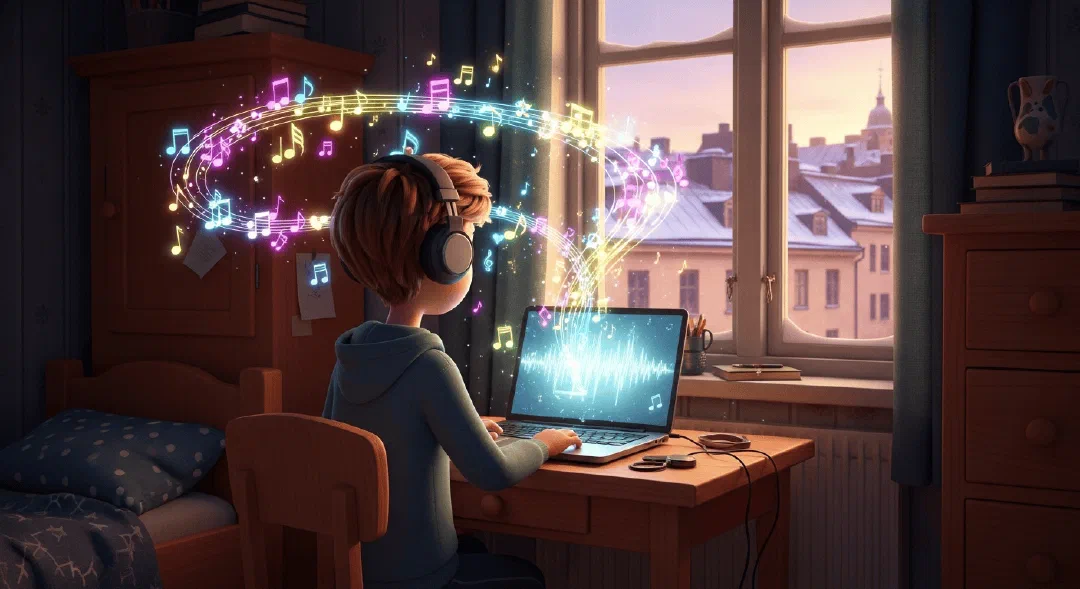
Before Spotify, getting a song wasn’t easy. A teenager in Sweden decided to turn all the music in the world into a library that fits in your pocket.
Life Before Streaming
Imagine you really love a song.
But you can’t just tap a screen and listen. You have to go to a store and buy a physical object that has your song on it.
That object might be a big round vinyl record. You have to put it on a spinning machine, and a tiny needle touches it gently to make sound come out.
Or a cassette tape — a little plastic box with a long magnetic ribbon inside. You could carry it around, but when one side finished, you had to flip it over. Skipping a song meant slowly rewinding.
Later, the shiny silver CD came along — cleaner sound, and you could jump to any track instantly.
But no matter which one, you had to buy them one by one. An album cost about as much as a nice family dinner.
The Internet Arrives
In the late 1990s, something huge changed — the internet was reaching more and more homes.
Someone thought: “What if music could travel from one computer to another, just like text does?”
That’s how the MP3 was born — a way to squeeze music files into tiny sizes while still sounding clear.
Suddenly, music could travel over the internet. In 2001, Apple launched iTunes, where you could buy a single song for less than a dollar and download it straight to your computer. Apple also made the iPod, a small device that could hold thousands of songs.
Music had moved into our pockets.
But Still Not Enough
One problem still wasn’t solved.
The songs you downloaded lived on your computer. Got a new computer? You had to move them all over. Computer died? Your songs were gone. Want a new song? You had to pay for it, wait for it to download, and let it take up space.
And if you loved music, buying song after song added up fast.
In Sweden, one teenager kept wondering: “Isn’t there a better way?”
The Swedish Teenager
His name was Daniel Ek.
Daniel had been a music lover since childhood. He loved listening, and he loved playing — he was in a band himself.
He also loved computers. At 13, he taught himself to write code, built websites, and made allowance money from them. By high school, he had already started several small companies.
Daniel kept asking himself one special question:
“What if everyone could listen to any song, anywhere, anytime — without buying it, without downloading it?”
From “Owning” to “Borrowing”
It sounded magical, but there’s a really simple way to picture it.
Downloading music was like buying a book. The book became yours — but your shelf could only hold so many, and moving them around was a pain.
What Daniel wanted was more like borrowing from a giant library. You don’t own every book, but you can walk in anytime and pick any one you want. And this library is enormous. Nobody else takes a book before you can.
That’s what “streaming” means.
Spotify Is Born
In 2006, Daniel and his friend Martin Lorentzon started a company in Stockholm, the capital of Sweden. They named it Spotify.
But to make this “music library” real, Daniel had to do something incredibly hard — get permission from the music companies.
Every song belongs to some music company. Daniel had to knock on their doors one by one and say: “Let me put your songs on Spotify. People can still listen. Musicians can still get paid.”
Most companies said no at first. “Who are you? Why should we trust you?”
Daniel spent two full years explaining his idea to music companies — presenting, drawing diagrams, running numbers — until they were willing to give it a try.
The Big Day in 2008
In October 2008, Spotify finally launched in Sweden.
You could open it on your computer, click on any song, and — in less than a second — the music flowed into your ears.
No waiting to download. No buying. No worrying that the song might disappear.
All of Sweden got excited. Word spread, and Spotify soon launched in the rest of Europe.
From that day on, Spotify started heading around the world. Today, over 180 countries can open Spotify and listen to music.
The World’s Music, Now Yours
Daniel’s childhood dream really came true.
A kid living high in the mountains can now listen to the exact same song, at the exact same minute, as a kid in a big city on the other side of the world.
Someone who has never left their country can hear music from someone singing halfway across the globe.
The song you want isn’t a record, a cassette, or a CD anymore — it lives right inside your pocket, waiting for you.
Did You Know?
- Daniel Ek never finished college. Most of his coding skills came from reading books and building websites himself. He often says: “The best teacher is the feeling of really wanting to learn.”
- Spotify’s engineers discovered an interesting rule: after you press play, the song has to start within 0.2 seconds. Any longer and people think, “Why’s it so slow?” Everything behind Spotify is designed around that tiny 0.2-second window.
- Spotify’s music library has over 100 million songs today. Even if you listened 24 hours a day without sleeping, it would take more than 11,000 years to hear every single one.
Think About It!
- Daniel compared streaming music to “borrowing from a library.” Do you think “borrowing” or “owning” fits something like music better? Why?
- Daniel knocked on music-company doors for two years to convince them to join Spotify, and was told “no” over and over. If you had a big idea but every grown-up said “no,” what would you do?
- Today, you can listen to the same song as a kid on the other side of the Earth, at the same moment. Does it matter that music can cross borders like this? Why?