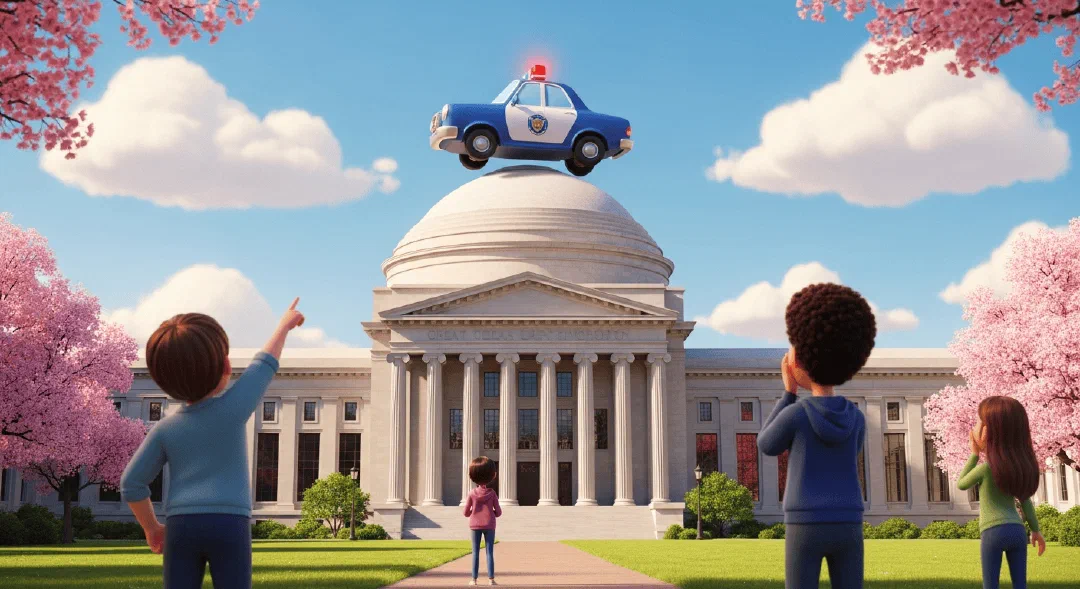
Why did students spend months secretly moving a police car onto the roof? Welcome to MIT, where the most hands-on students in the world come to learn.
How Did a Police Car End Up on the Dome?
On a morning in 1994, people walking into MIT (Massachusetts Institute of Technology) stopped in their tracks and looked up.
Sitting on top of Building 10’s great dome was a police car. Inside, a fake police officer held a box of donuts.
This wasn’t vandalism. It wasn’t a prank. It was the engineering masterpiece of a group of students who spent months planning it. They studied the roof’s structure, calculated weight, figured out how to lift a car to the dome in the middle of the night without anyone noticing. Every single step was carefully calculated to keep everyone safe.
What did MIT do? They didn’t punish anyone. Instead, everyone agreed it was proof that these students truly understood engineering.
At MIT, this kind of bold creative challenge has a special name: Hack. Not the computer hacker kind, but “using clever engineering to do something that makes everyone amazed.” Moving a police car to the roof is MIT’s spirit in a nutshell: we don’t just read about things, we make them.
A Person Who Believed in Hands-On Learning
MIT’s story starts in 1861.
That year, a man named William Barton Rogers did something bold. He founded a university, but this one was completely different from all the others.
Back then, most universities taught the same way: sit in a classroom, listen to professors talk, read thick textbooks, memorize formulas and theories. But Rogers thought that was wrong. He believed real learning wasn’t just about thinking with your brain. You had to use your hands.
He gave MIT a motto: Mens et Manus. In Latin, it means “Mind and Hand.” Whatever your brain thinks up, your hands have to be able to build it. If you learn how a machine works, you should build one yourself.
This was the age of the Industrial Revolution. America was building factories everywhere, laying railroad tracks, inventing new machines. The country didn’t need theorists. It needed people who could make things with their hands. Rogers’ idea arrived at exactly the right time.
MIT was different from day one. And that “hands-on” spirit is still what makes MIT special today.
The Police Car Was Just the Beginning
Putting a police car on the roof was just a warm-up for MIT students. They once redesigned the dome to look like R2-D2 from Star Wars. They once made a giant balloon with “MIT” written on it pop up in the middle of a football field during a game between Harvard and Yale. The other team’s fans were furious, but everyone had to admit: these engineers could do anything.
But Hack is just the fun part. MIT’s labs and classrooms have also created things that changed the world.
In 1962, some students thought computers shouldn’t just do boring calculations. So they wrote a program called Spacewar! Two spaceships shooting at each other on a screen. This was the world’s first video game, twenty years before Nintendo’s first game console.
MIT Media Lab later partnered with the LEGO company and created LEGO Mindstorms—a LEGO kit you can assemble, code, and make move on its own. The screen on Kindle e-readers that looks like paper and doesn’t hurt your eyes uses E Ink technology that came straight out of MIT labs.
Then there was Professor Harold “Doc” Edgerton, who invented Strobe Photography. He photographed a bullet going through an apple in a single instant. He captured milk splashing into a bowl. Those photographs showed people things their eyes could never catch.
Beavers, Numbers, Iron Man, and Free Classes
MIT’s mascot is a beaver. In nature, beavers are the engineers. They understand how water flows and how wood fits together, and then they build dams. MIT students do exactly the same thing.
The people who graduate from here do incredible things. Buzz Aldrin got his degree from MIT and walked on the moon. About one-third of NASA’s astronauts are connected to this school somehow. Even Tony Stark from Marvel’s Iron Man movies is written as an MIT graduate. When a real university becomes so famous that fictional superheroes want to attend, that’s pretty cool proof of excellence.
But maybe the coolest thing MIT ever did wasn’t sending people to the moon. Maybe it was sending knowledge to the whole world. They created something called OpenCourseWare—over two thousand courses, completely free, online. No matter where you live, you don’t pay a penny. You can take the same class as future Nobel Prize winners from the same professor.
MIT believes knowledge belongs to everyone. This might be their coolest Hack ever.
Did You Know?
- Only twice a year, the sunset’s angle perfectly lines up with MIT’s 251-meter-long corridor. Students call this MIThenge, and it only lasts a few minutes. Miss it, and you wait six months for the next one.
- Every building at MIT is named with a number. Students regularly say things like “I’ll meet you at Building 32.” Even professor office addresses look like “32-D463.”
- MIT put over two thousand courses online for free, and anyone in the world can learn. This program is called OpenCourseWare. Since 2001, over three hundred million people have used it.
Think About It!
- MIT students moved a police car onto the dome, and the school didn’t punish them at all. They thought it proved real engineering skill. Where do you think the line is between “a clever challenge” and “breaking the rules”?
- MIT’s motto is “Mind and Hand”—real learning means building things, not just reading about them. Have you ever learned something better after making it with your own hands?
- MIT put their courses online for free, but some people say watching videos isn’t the same as sitting in a classroom with classmates. What do you think free online courses are missing? What do they have that regular classes don’t?