“There’s got to be a better way.” — Reed Hastings, after receiving a forty-dollar late fee on a DVD rental
In 1997, How Did You Watch a Movie?
Picture yourself in 1997. You really want to watch a movie. What do you do?
You have to get a ride to a video rental store called Blockbuster. It’s a big building stuffed with thousands of VHS tapes and DVDs. You search the shelves and finally find the movie you want.
But there’s a catch. Blockbuster’s rule: you can only keep it for three days. If you return it late, they charge $5 per movie per day. If you rented five movies and returned them a week late, your late fee could be $50 — almost a whole month’s allowance for a kid.
One night in 1997, a computer engineer named Reed Hastings rented a movie called Apollo 13 from Blockbuster. He got so absorbed with other things that he forgot to return it. By the time he remembered, it was very overdue. He walked into the store, and the clerk said:
“Your late fee is forty dollars.”
Forty dollars! Sitting in his car, Reed thought: “Why does it have to be this way? Why do I have to drive to a store? Why are there fines? Isn’t there a smarter way?”
Blockbuster’s Money Secret
The more Reed thought about it, the more curious he got. He started investigating how Blockbuster actually made money.
Then he discovered something shocking —
Blockbuster was earning hundreds of millions of dollars every year from late fees alone. Late fees made up a huge chunk of the company’s profit.
In other words, part of Blockbuster’s business model depended on customers making mistakes. Every time someone forgot to return a tape, money rolled into Blockbuster’s pocket.
Reed grew even more convinced: “There has to be a better way to do this.”
Fifty Wild Ideas on the Drive to Work
Reed had a friend named Marc Randolph. The two of them drove to work together every day, and their favorite topic was: “If we started a company together, what would we make?”
They brainstormed idea after idea in the car:
“Custom shampoo — made specifically for your hair type?” “Customized baseball bats — one for every kid?” “Made-to-order surfboards — mailed to your house?” “Sporting goods by mail?”
They came up with close to fifty different business ideas in the car, and shot down every single one of them. Too expensive. Too complicated. Too much trouble.
Until one day, a new idea popped up:
“What about mailing movies? Send the movie right to the customer’s door?”
Reed and Marc looked at each other: “This… might actually work.”
The Disc They Mailed to Themselves
But there was still one big problem to solve —
A DVD is a thin plastic disc. If you put it in an envelope and sent it through the postal system — past sorting machines, mail bags, metal mailboxes — would it get crushed? Bent? Scratched?
They needed to find out first.
Reed picked up an old CD, slid it into a regular envelope, stuck a stamp on it, and mailed it to Marc’s house.
A few days later, the envelope arrived. Marc carefully tore it open —
The disc was perfectly fine.
They jumped for joy. Netflix’s whole dream started with that one envelope they’d mailed to themselves.
The Red Envelope Is Born
In 1998, Netflix officially launched.
The name came from combining “Net” (for the internet) and “Flicks” (slang for movies).
It was incredibly simple to use — you opened your computer, went to the Netflix website, picked a movie you wanted to watch, and clicked a button.
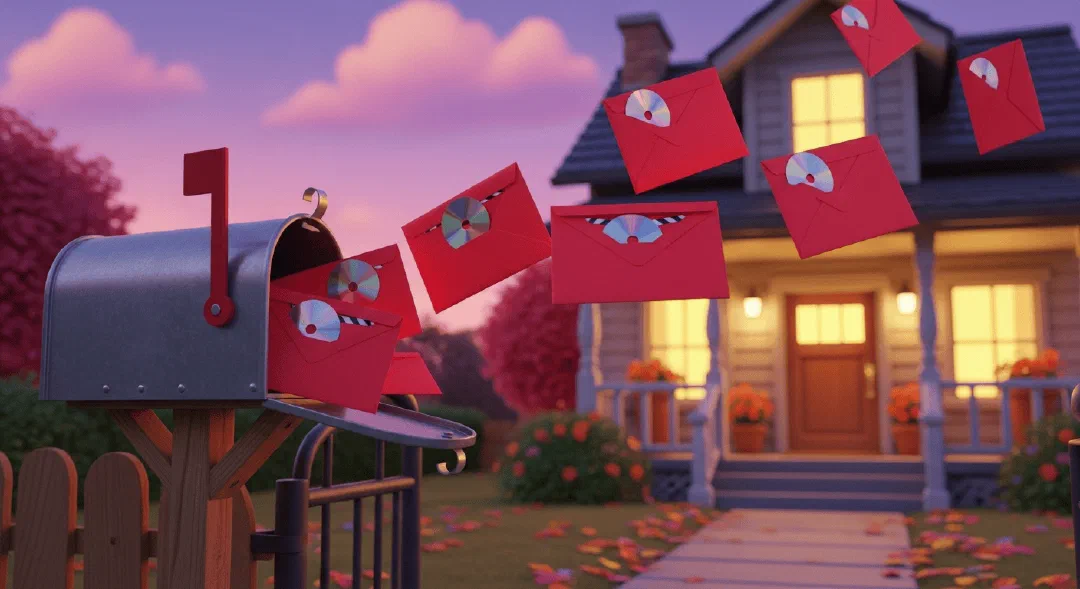
A day or two later, a big red envelope arrived at your door. Inside was the DVD you wanted.
When to watch? You decide. Finish watching? Pop the DVD back into the red envelope, drop it in your mailbox, send it back.
No late fees. No driving to the store. No pressure to return it in three days.
Everything was up to you.
The Queue and the Computer That Knew What You’d Like
Netflix came up with two more clever inventions that nobody had ever tried before.
The first was called the Queue — a list where you could write down every movie you might want to watch in the future, in order. When you mailed one disc back, the next one on your Queue shipped out automatically. No more wondering, “What should I watch next?”
The second was a computer system called Cinematch. It quietly remembered which movies you liked and didn’t like, then secretly recommended “the next one you’re probably going to love.”
This idea was brand new and felt like magic at the time. But today, every time you open YouTube and see “Recommended For You,” or Spotify and see “Discover Weekly,” or TikTok and get served a “You might like this” clip — that whole idea traces back to Netflix’s Cinematch.
Netflix Changed the Rules of the Game
In the Blockbuster era, the rental store was the king. They decided what you watched and when you returned it.
But Netflix changed all of that.
Suddenly, you weren’t a passive customer anymore. You were the boss. You decided when to watch, how long to watch, when to return. Nobody rushed you. Nobody fined you.
Everybody hates being fined. Everybody loves freedom. So Netflix just kept growing.
The Day Blockbuster Laughed at Them
By 2000, Netflix was still a young little company, and it nearly ran out of money.
Reed did something bold. He flew to Texas to meet with Blockbuster’s executives and made them a big offer:
“Fifty million dollars. Buy Netflix. Your physical stores plus our online service — together, we could become something incredible.”
Blockbuster’s executives looked at Reed, and they laughed.
“We don’t think this is going to be a big market,” they said.
Fourteen years later — Blockbuster, which once had over 9,000 stores around the world, closed down store after store. The very last one shut its doors in 2014.
And Netflix? It became a company used by more than 200 million people every day.
Did You Know?
- Why is it called Netflix and not DVDflix? Because from the very beginning, Reed was already dreaming of a day when movies would stream directly into people’s homes through the internet, with no DVDs needed. He hid that secret dream right in the company’s name.
- The year Netflix launched, there were only about 900 DVDs on the entire website. Today, Netflix’s library is many dozens of times bigger.
- The red envelope became Netflix’s most famous symbol. Even American mail carriers would spot one and think: “Ah, another Netflix package.”
Think About It!
- In 1997, everyone thought “driving to a store” was the only way to rent movies. Is there anything in your life where you feel: “There’s got to be a better way”?
- Reed and Marc went through almost fifty ideas in the car before landing on the right one. Have you ever tried many different approaches before finally finding the one that worked?
- To find out if their idea would work, Reed and Marc first mailed a CD to themselves as a small test. Before doing something you’re not sure about, would you also try a “small experiment” first? What would your experiment look like?