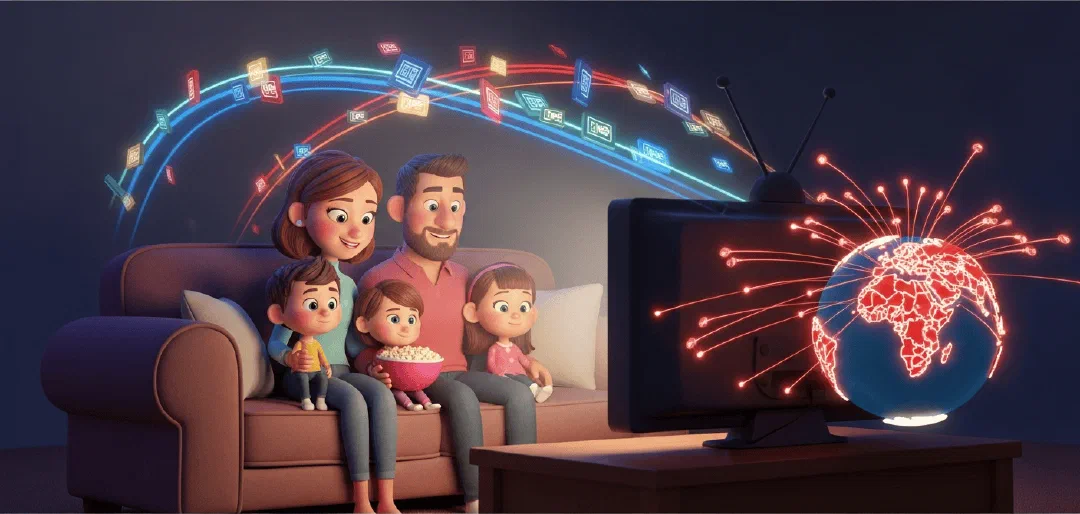
The internet got faster. Red DVD envelopes weren’t the only choice anymore. In 2007, Netflix made a bold decision: movies would stream directly to your home.
The Internet Got Faster
Remember that beeping sound? In the 1990s, if you wanted to connect to the internet, your computer would make a weird beeping, hissing noise. That was dial-up internet. It was painfully slow. So slow that downloading one movie could take a whole week.
But in the 2000s, something changed. Fiber-optic cables and broadband rolled out to cities and countryside. Internet speeds suddenly got a hundred times faster.
Reed Hastings and his team noticed. They asked: “If the internet is fast enough now, why can’t people watch movies online? Why do we still need to mail DVDs?”
2007: Press a Button, Watch Instantly
In January 2007, Netflix launched a new feature called “Watch Now.” For the first time, you could press a button and have a movie stream straight to your computer. No waiting for the mail carrier. No waiting three days. Watch it right away.
This was called streaming. Movies flowed into your home like a river.
But here’s the clever part. Netflix didn’t say: “Goodbye DVDs, we’re all-streaming now.” They kept both services. You could still order DVDs, or watch online. It gave everyone time to adjust.
Netflix Decides to Make Its Own Shows
After Netflix started streaming, all the Hollywood movie studios and TV networks got scared. They thought: “If everyone’s watching online, who’s going to subscribe to our channels anymore?”
So they started jacking up prices on Netflix. Five million dollars for the rights to a movie this year? Next year, ten million. The numbers kept climbing.
Netflix thought: “Enough. Let’s make our own shows.”
In 2013, Netflix released its first big original series, called House of Cards. They hired famous actors and made a show that got grown-ups hooked.
The moment it dropped, people all over the world were talking about it. Netflix had proven something big — they weren’t just a company that played movies. They could also make great stories.
After that, Netflix kept making show after show that people couldn’t stop watching.
One of the most famous was Stranger Things.
The show took off around the world the moment it launched. Kids loved it. Grown-ups loved it. Parents even sat down to watch it together with their children.
Netflix was no longer just “a company that plays movies” — they had become one of the biggest “story factories” in the world.
Binge-Watch an Entire Season at Once
Netflix also did another thing that turned the whole TV world upside down — they changed how shows got released.
How did traditional TV do it? They’d air one episode on Monday, and then you’d have to wait a whole week to see the next one.
But Netflix said: “Why wait? Here’s the whole thing, all at once.”
An entire season — 13 episodes, 20 episodes — all showing up on the same day. How much, how fast, how long? That’s up to you.
The result? Lots of people, the moment a new season dropped, would curl up on the couch for a whole weekend and watch the whole thing from start to finish. In English, this is called binge-watching — marathon watching.
It’s like eating a pizza. Traditional TV gives you one slice at a time and says “come back next week.” Netflix brings you the whole pizza and says: “eat as many slices as you want.”
Netflix’s Little Magic Tricks
Netflix has a few little magic tricks hidden inside that make it really hard to stop watching.
The “Skip Intro” button: A few seconds into each episode’s opening credits, a little “Skip Intro” button appears on screen. Netflix noticed people were always skipping intros manually, so in 2017 they built a dedicated button just for that. It sounds simple, but a whole team of engineers spent a long time building it — every time you press it, you’re using a tiny Netflix invention.
Auto-play next episode: Have you noticed — the second one episode starts ending, the next one just starts playing on its own? Netflix designed it that way on purpose. They figured out that if they gave you 3 seconds to decide “should I keep watching?”, lots of people would say “Okay, enough for today.” But if the next episode just pops up? You think: “Eh… okay, just one more episode.”
Cliffhanger endings: Netflix’s writers deliberately make the last scene of every episode feel like you’re on the edge of a cliff — the hero almost gets caught, the villain just appeared, the mystery isn’t solved yet. You can’t help pressing “next episode.”
That’s why once you open Netflix, it’s so easy to end up watching for hours.
The Algorithm Knows What You Like
Netflix has another magic secret. Their recommendation system is incredibly smart.
Have you noticed that the recommendations on Netflix’s home screen are usually spot-on? You think: “Wait, that actually looks interesting!”
How do they do it? Algorithms.
Netflix’s computers watch what you do. What shows do you watch? How long do you watch? Did you finish it? Did you rate it five stars or one? They watch millions of people, and they find patterns.
For example, they figured out: people who love Stranger Things usually also love The Witcher. Horror fans usually love thrillers. Families with kids usually watch animated shows.
So when you finish Stranger Things, Netflix thinks: “Hey, this person might love The Witcher.”
And the system is usually right. That’s why Netflix’s recommendation engine is smarter than most other companies'.
You’re Watching a Korean Story, and a Kid in Brazil Is Watching Too
Imagine this. It’s Saturday night. You curl up on the couch, open Netflix, and watch a show made in Korea. That same night, a kid in Brazil is watching the same show. A family in Japan is watching it too. The US, France, India — people all over the world are watching the same story.
It didn’t use to be this way. Before, American shows were only watched by Americans. Korean stories stayed in Korea. Japanese anime took years to reach other countries. Every country’s stories were locked behind invisible walls.
Netflix tore those walls down.
They went to Korea and hired Korea’s best directors to tell stories. They went to Japan and found Japanese writers. They went to Spain, Brazil, India — anywhere a good story lived. Then they dubbed those stories and added subtitles in dozens of languages, so everyone could understand.
The result? In 2021, a Korean show called Squid Game became the most-watched show in Netflix history. It wasn’t American. It was in Korean. But the whole world watched, and the whole world talked about it. Your classmates probably saw it too.
This is Netflix’s real superpower: great stories don’t have borders. A good story — no matter which country it comes from — can make the whole world laugh, hold its breath, and feel something together.
What One Late Fee Taught Us
Reed Hastings got angry about a forty-dollar late fee. Most people would have just complained. But he was different — he asked one question: “Is there a better way?” And then he actually went and did it.
Netflix’s story teaches us that when something annoying comes up, don’t just complain. Stop and ask: “Is there a better way?” Maybe your answer will be the beginning of the next world-changing thing.
Did You Know?
- When Netflix first launched streaming, the library had only about a thousand movies. Today they have more than 15,000 movies and shows available in over 190 countries.
- The word binge-watching became so popular that in 2015 the Oxford English Dictionary officially added it as a real English word. Netflix literally changed the language.
- Netflix’s algorithm knows exactly which second you pressed pause. If lots of people pause at the same moment, Netflix can tell that scene must be especially captivating.
Think About It!
- Netflix lets you decide when to watch and how much to watch. But some people worry this makes it hard to stop. How do you think we should balance “freedom” with “managing your own time”?
- You can now watch Korean, Japanese, and Brazilian stories from your own country. Do you think watching stories from other countries changes how you feel about those places?
- If you could make a show that every kid in the world would want to watch, what story would you tell? Why do you think it would move kids from different countries?