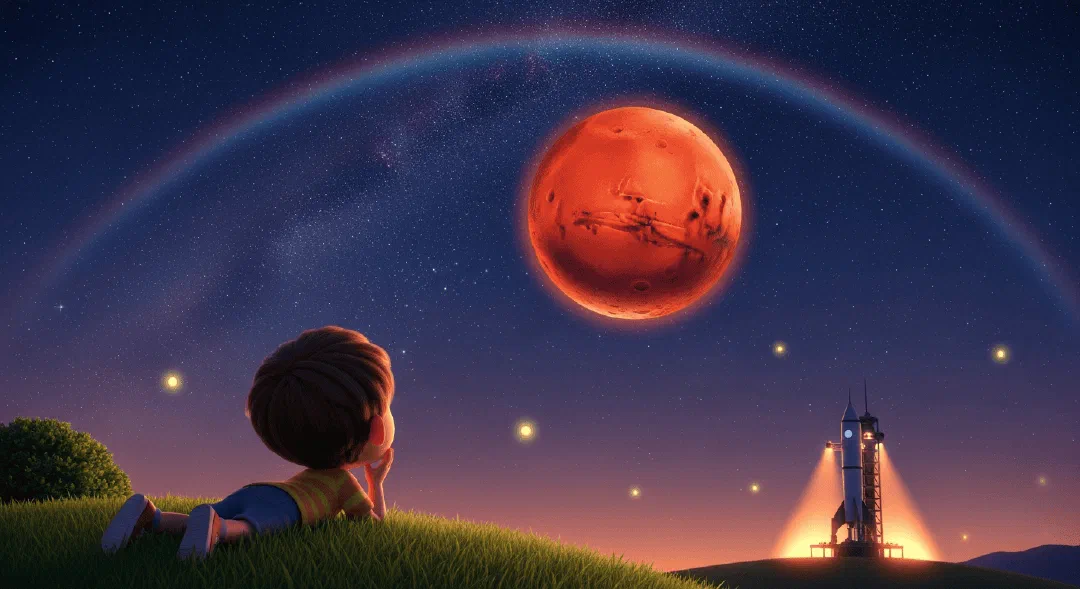
If one day humans could live on Mars — how would we get there? That “too crazy to be real” question gave birth to a new kind of company.
The Question from the Night Sky
Imagine lying on the grass on a summer night, looking up at the stars.
One tiny red dot among them is Mars. It’s incredibly far away — even on the fastest rocket, the journey takes many months.
Most people glance at Mars and look away. But in the late 1990s, a young inventor named Elon Musk stared at Mars, and a question popped into his head:
“One day, could humans live up there?”
The more he thought about it, the more excited he got. He even imagined a project called “Mars Oasis” — a real greenhouse on Mars, where people could grow vegetables and turn Mars into a second home for humanity.
Just imagine — you, as a space farmer, growing tomatoes on another planet!
A Jaw-Dropping Bill
Elon began researching how to get to Mars. He discovered a big problem:
Rockets are unbelievably expensive.
Back then, building a single big rocket was like constructing a 20-story-tall skyscraper packed with millions of tiny precision parts. Every single screw, every single wire had to be inspected by engineers — one at a time, by hand, over several years.
But the most unbelievable part? Each rocket that took so much effort to build could only be used once. After it flew into the sky, it was garbage. To launch again, you had to start from scratch and build another one.
Imagine if your parents drove a car to the supermarket today, and then — as soon as they got home — threw it into the ocean. Tomorrow, to go shopping again, they’d have to buy a whole new car, and dump that one too.
That’s exactly how space rockets were used. Silly, right? And terribly wasteful.
Elon thought: “What if rockets could land themselves, like airplanes, and be used again?”
If every airplane flight destroyed the plane, tickets would cost a fortune. Because planes can fly over and over, flying is something most people can afford.
Why couldn’t rockets work the same way?
Nobody Believed Him
Elon brought his idea to big companies and engineers.
Everyone shook their heads: “Impossible. Rockets fly too fast and get too hot. Landing them gracefully just can’t be done.”
“That’s something out of a sci-fi movie. Not something you can really build.”
But Elon didn’t believe in the word “impossible.” He thought: with smart enough people, enough time, and enough hard work, it could be done.
A Brand New Company
In 2002, Elon started a new company called SpaceX.
SpaceX stands for “Space Exploration Technologies.”
Its mission was special. Not just to make money. Not just for fun. But to do something huge — make space travel affordable, and one day, actually let humans live on Mars.
A Small Warehouse in California
SpaceX’s first office was a small warehouse in California.
There were no shiny hallways from a sci-fi movie. Just desks, chairs, piles of parts, and a group of young engineers.
Most of them had just graduated. They had never built a rocket before. They had never launched anything into space. But they believed in Elon’s dream.
They knew one thing: they were going to fail. Probably many times.
But they also knew that if they succeeded, space travel would change forever.
Why Travel So Far?
You might wonder: “Earth already has so much to deal with. Why go to Mars?”
Elon’s answer was this:
Imagine you packed all your favorite toys into one single box. If that box got crushed somehow, what would you do?
Earth is humanity’s only home. One day, if something happens to Earth — a big asteroid, or the climate getting too hot — humans would have nowhere else to go.
If we could build a second home on Mars, it would be like splitting our toys across two boxes. Even if one gets damaged, the other is still safe.
It’s not about running away from Earth. It’s about giving humanity “one more choice.”
Did You Know?
- At its closest, Mars is about 55 million kilometers away from Earth. Even on the fastest rocket, the trip takes nearly 7 months.
- Mars has only about one-third of Earth’s gravity. On Mars, you could jump three times higher than you can here — bouncing around like a little superhero.
- In space, there’s no air, so rockets can’t fly with wings like airplanes. Instead, they keep shooting gas downward to push themselves upward — just like a balloon flies off when you let go of the opening.
Think About It!
- Everyone said “rockets can never be reused,” but Elon thought they could. If you had an idea nobody believed in, what would you do?
- Elon compared rockets to “airplanes you can only use once.” Can you think of something in your life that could be reused, but usually gets thrown away?
- If ordinary people could buy tickets to travel to space one day, what interesting things do you think would happen?