Three failures, three explosions. The fourth time — everything about space history changed.
A Very Important Launch Day
In March 2006, there was a tiny island in the middle of the Pacific Ocean.
On that island stood a group of young engineers, staring at a silver rocket. This was SpaceX’s very first rocket, named Falcon 1.
Falcon 1 was named after the Millennium Falcon from Star Wars. Elon Musk had loved that movie since childhood.
Today, this rocket would fly for the very first time. If it succeeded, SpaceX would prove it could really build rockets.
The engineers’ hearts were pounding. The countdown began: “10, 9, 8… 3, 2, 1!”
Just a Few Seconds After Liftoff
The engines roared to life. Flames shot out of the rocket’s tail. Falcon 1 slowly lifted off the ground and climbed higher. Everyone held their breath — “Did we do it?”
Just a few seconds later, with a deafening boom — “BANG!” — the rocket burst into flame, lost control, and tumbled out of the sky.
The first launch had failed. The control room went silent for a long time. Some people couldn’t speak through their tears.
But Elon stood up and said something the team would never forget: “We know what went wrong. Let’s build another one.”
Again… and Again
The engineers gathered up the wreckage and carried it back to the lab in California. Over cups of coffee, they debated: Was it the fuel line? The engine getting too hot? The wind? Find the problem, fix it. Then build a new rocket.
In 2007, a second Falcon 1 was ready. Everyone flew back to the same tiny island, counted down, launched — and this one exploded too.
In 2008, the third Falcon 1 lifted off. This one flew higher. The team got more and more excited: “It looks like we’re going to make it!” But halfway up, something went wrong, and it tumbled back down.
Three failures in a row.
SpaceX was running out of money. Elon poured his own savings into the company just to keep it alive for a little longer. Many people thought this little company had reached the end of the line.
But the engineers didn’t give up. One thought kept them going: “We’re only one step away from success.”
The Last Chance
On September 28, 2008, SpaceX prepared to launch the fourth Falcon 1.
Everyone knew: this was the last chance. If it failed, the company would really be finished. If it succeeded, the future would continue.
The weather was beautiful that day. The sun was bright, the sea breeze was cool. In the control room, the engineers looked at each other. Nobody said a word. Everyone silently begged the rocket: “Please, this one has to work.”
The countdown began: “10, 9, 8…”
Into Space
The engines ignited. Falcon 1 lifted off, climbing higher and higher.
The first stage separated — smoothly. The second stage ignited — successfully. It kept rising, through the clouds, through the atmosphere, until finally — it entered space.
The control room erupted in cheers. Some people cried. Some hugged and jumped. Some dropped to the ground because their legs had gone weak from joy. Elon himself said he nearly fainted at that moment.
Three failures finally turned into one success. SpaceX had done it.
A Christmas Gift from NASA
But what really gave the company a second life was a phone call a few months later.
A few days before Christmas 2008, Elon picked up the phone in his office. On the other end was NASA — the United States space agency, the most famous and respected space organization in the world.
NASA said: “We saw your successful launch in September. We believe SpaceX can do it. We’d like you to help carry supplies to the International Space Station — and maybe one day, astronauts too.”
Elon’s hands were shaking. The first thing he said to NASA was: “I love you guys.”
This phone call was more valuable than anything else. It wasn’t just a job — it was a huge vote of confidence. The most experienced, most demanding space agency in the world was willing to trust a company that was only six years old.
From that day on, SpaceX was no longer the little startup everyone laughed at. Overnight, it became the most exciting new star in the space world.
A Bigger Challenge — Landing the Rocket
But SpaceX didn’t stop there.
In the years that followed, they built a bigger, more powerful rocket called Falcon 9.
Falcon 9 could carry satellites to space, and even spacecraft to the International Space Station.
But Elon wanted to do something even crazier — to let the rocket land itself after flying up.
Why? Because a reusable rocket is the only way to make space travel truly affordable.
The engineers said: “This is incredibly hard.”
Elon said: “Then we’ll find a way to make it simple.”
Try After Try, Explosion After Explosion
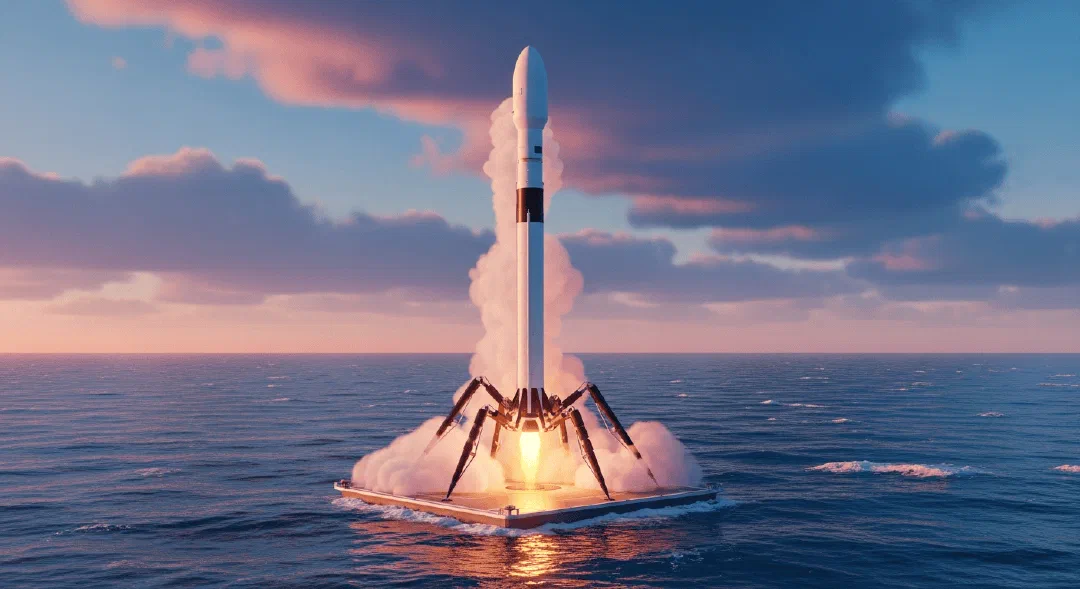
Falcon 9’s first attempt to land was on a ship in the middle of the ocean.
The result — it tilted sideways, crashed onto the ship, and exploded.
Second time — it tipped over while landing. Another explosion.
Third time — it looked stable, then fell over at the last moment. Another explosion.
SpaceX edited all these crashes together into a video they called “How Not to Land an Orbital Rocket Booster.”
Why did they share these failures publicly? Because they wanted to tell the world: there’s no shame in failing. Failure is just part of the road to success.
A Historic Day
On December 21, 2015, Falcon 9 was ready to launch again from the Florida coast.
It lifted off, released its cargo into space, then began slowly flying back toward Earth.
Using its engines to steer, it gradually slowed down, descending gently.
Then — it touched down softly on the ground, standing upright like a perfectly balanced pencil.
No tipping over. No explosion.
People all over the world watched the live broadcast in disbelief. Someone described it this way: “It’s like dropping a pencil from a skyscraper and having it land standing on end.”
SpaceX had done it. Reusable rockets had become real.
Failure Isn’t the End
From that moment on, SpaceX’s rockets landed more and more smoothly.
Today, the same Falcon 9 has been reused dozens of times. This has dramatically lowered the cost of getting to space.
More countries, more companies, more schools can now send their own small satellites into orbit.
It all started with those three “BANG!” explosions.
Did You Know?
- Falcon 1 was the world’s first liquid-fueled rocket built by a private company to successfully reach space. Before that, only national space agencies could do it.
- When Falcon 9 lands, it slows down from over 2 km/s (faster than a bullet) to roughly walking speed. It does this entirely by firing its engines in reverse — with timing so precise, it can’t be off by even a second.
- After signing the NASA contract, SpaceX didn’t just carry supplies to the International Space Station. Years later, they actually carried American astronauts to space — the first time the United States launched astronauts from its own soil in about 10 years.
Think About It!
- SpaceX exploded three times before succeeding once. Have you ever learned something only after failing many times? How did that feel?
- SpaceX’s engineers call failure a “learning opportunity.” Can you look at your last failure and find something it taught you?
- SpaceX turned “use-it-once” rockets into “reusable” rockets. What things in your own life could be reused that usually get thrown away?