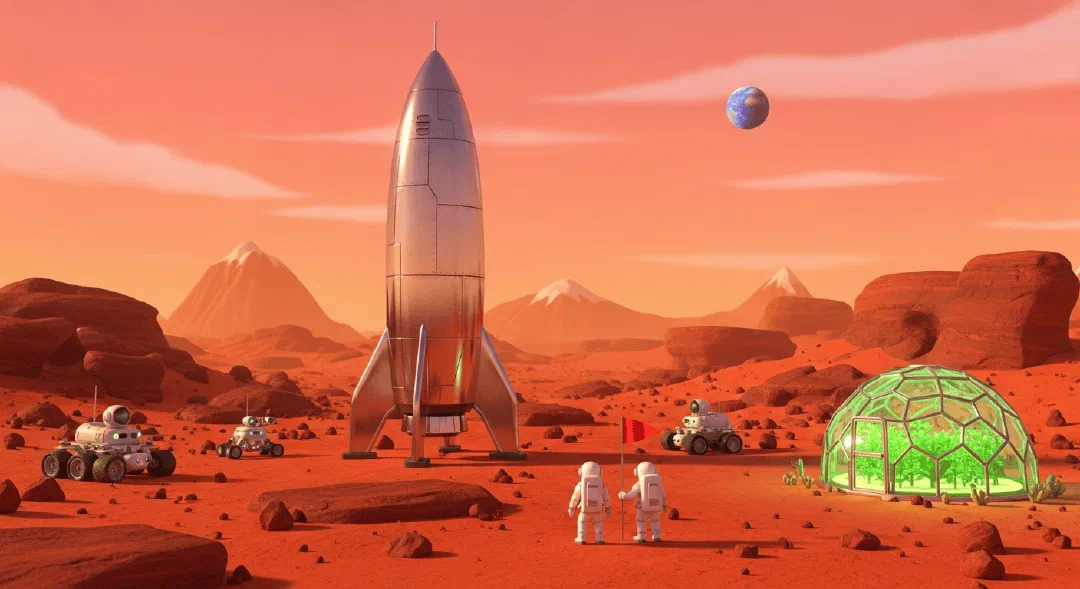
A spaceship taller than the Statue of Liberty is getting ready to carry humans to Mars. This isn’t science fiction — this is what SpaceX is building right now.
A Spaceship Straight Out of Science Fiction
Imagine a shiny silver spaceship standing on the coast of Texas.
It’s taller than a 30-story building, taller than the Statue of Liberty — a giant gleaming rocket pointed at the sky.
Its name is Starship.
This is the biggest and most important spaceship SpaceX has ever built. Elon Musk has never forgotten his childhood dream — sending humans to Mars. And Starship is what will finally make that dream possible.
Why Is Starship So Important?
Remember: Falcon 9 can carry satellites into orbit and take people to the International Space Station. But flying to Mars is a completely different challenge.
Mars is over 55 million kilometers away. The journey takes 6 to 9 months.
A spaceship like that has to be:
One — gigantic: big enough to carry dozens of people, plus food, oxygen, and tools. Two — incredibly powerful: strong enough to escape Earth’s gravity. Three — reusable: otherwise, getting to Mars would cost an impossible amount.
Starship was designed to do all three of these things.
The Big Moment of 2020
While Starship was still being tested, SpaceX also achieved something amazing.
On May 30, 2020, two American astronauts — Doug Hurley and Bob Behnken — climbed into a SpaceX Dragon spacecraft, mounted on top of a Falcon 9 rocket. They launched from Florida and flew to the International Space Station.
This might sound ordinary, but it was extraordinary.
For nearly 10 years before that, American astronauts had to catch rides on Russian rockets to reach the space station. America’s own spacecraft had all retired.
SpaceX changed that. They became the first private company in history to carry astronauts into orbit.
Things that only governments used to do, a company could now do too.
A Plan to Bring Internet to the Whole World
SpaceX also had another amazing plan — to bring the internet to every corner of the world.
Imagine a tiny village high in the mountains with no power lines and no cell towers. Or a ship far out at sea, thousands of kilometers from land.
Before, places like these couldn’t really get online.
But SpaceX thought: “What if the internet didn’t need cables on the ground? What if it came from the sky?”
This plan is called Starlink.
SpaceX launched thousands of small satellites into space. Together, they circle Earth like an invisible internet blanket covering the whole planet.
With just a small dish at your house, you can connect to these satellites. A cabin in the mountains, a tent in the desert, a research station in Antarctica — all can now get online.
Today, schoolkids in Africa use Starlink to study online. Farmers in South America use it to check weather forecasts. Sailors use it to video-call their families from the middle of the ocean.
The Mars Plan — Now Live
Now back to the biggest dream: Mars.
SpaceX’s plan sounds like a movie, but step by step, it’s really happening:
Step one: send an empty Starship to Mars, carrying tools, food, and robots.
Step two: send more Starships with more supplies, until there’s a real base set up on Mars.
Step three: send human astronauts. They’ll live at the base, do science, and build more homes.
Final step: more and more people travel to Mars. Decades from now, there might really be a small city there.
Still Testing, Still Learning
Starship is still being tested today.
On some flights, it successfully flies to the edge of space and glides back down. On other flights, it explodes mid-air.
But every failure teaches the engineers something new. It’s the same thing SpaceX has been doing from day one: fail, fix, try again.
In April 2023, Starship completed its first full integrated flight test. It flew to the edge of space before falling back to Earth. It wasn’t perfect — there were explosions and failures — but it showed the world this giant spaceship could really fly.
Every test brings it closer to Mars.
Catching a Rocket with “Chopsticks”
In October 2024, SpaceX did something the whole world couldn’t believe.
That day, the giant bottom section of Starship — taller than a 20-story building — slowly fell back from the edge of space, heading toward the launch tower.
Normally, rockets need to land on their own legs. But this time, SpaceX decided not to let it land that way.
On the launch tower were two enormous mechanical arms that looked just like a giant pair of “chopsticks.” When the rocket reached the right spot, the arms suddenly closed — snap! — and caught the rocket right out of the air.
The rocket just hung there in mid-air, held steady by two long metal arms. The whole world watched the live stream with their jaws on the floor.
Why do this? Because this way the rocket doesn’t need heavy landing legs, and it can be placed back on the launch pad faster, refueled, and flown again. It’s like a relay race — passing the baton from one flight to the next.
No one had ever done this before. Many engineers, when they first heard the idea, said: “There’s no way.”
But SpaceX, once again, turned “impossible” into “done.”
You and the Future
You might be thinking: “What does Mars have to do with me?”
Actually — a lot.
The kid reading this story right now might be one of the first humans to walk on Mars.
Or you might be the engineer who designs the life support system for the first Mars base.
Or you might be the scientist who discovers signs of ancient life on Mars.
SpaceX has proven something important:
The future isn’t something that “happens to us.” The future is something we build, step by step.
Every great idea sounds crazy when it first appears. Every success is built on top of many failures. Every person who changes the world starts from the same little seed — “I want to try.”
Did You Know?
- Starship is built entirely out of stainless steel. The same cheap, tough, heat-resistant metal that grandma’s cooking pot is made of.
- There’s only a brief “launch window” every two years when Earth and Mars line up for the shortest, most fuel-efficient trip. Miss it, and you have to wait another two years.
- At night, when a fresh batch of Starlink satellites flies overhead just after launch, they look like a string of pearls sliding across the sky. Many people have photographed this magical sight.
Think About It!
- SpaceX has made space travel much cheaper. If ordinary people could go to space someday, what would you most want to see Earth look like from up there?
- Starlink lets people in mountains, deserts, and Antarctica get online. If you could invent a new thing to help the world, what problem would you want it to solve?
- If you could live on Mars for three years, would you go? What would you miss the most about Earth?