Building a car as fast as a sports car, as cool as a spaceship, and cheap enough for ordinary families — that was Tesla’s next dream.
The Dream Wasn’t Over
Remember Tesla’s first car, the Roadster? It was fast and beautiful, but only a few could afford one.
Elon Musk knew this wasn’t the finish line. He asked himself a question: “How do we make every car in the world electric?”
The answer was simple — but doing it was very hard. They had to build an electric car families could actually afford.
A Secret Three-Step Plan
Back in 2006, Elon had already written a document called “Tesla’s Secret Master Plan.”
It had three steps:
One: build a cool, expensive sports car to prove electric cars can be fast and beautiful. Two: use the money from step one to build a better car more people can afford. Three: use the money from step two to build a car everyone can afford.
It was like climbing a ladder. Each rung helps you reach the next one.
The Roadster was step one. Now it was time for step two.
Meet the Model S
In 2010, Tesla announced a brand new car: the Model S.
The Model S wasn’t a sports car. It was a family sedan. Four doors, five seats, and a big trunk. It looked like an ordinary family car — but it was anything but ordinary.
It could go from zero to 96 km/h in just 5.9 seconds, faster than most new cars on the road. On a single charge, it could drive nearly 500 kilometers. You could go from home to the beach and back without stopping.
The coolest part? The Model S had a computer inside it as smart as a laptop. In the middle of the dashboard was a huge touchscreen showing maps, music, and everything about the car.
Even more amazing: the Model S would download new features automatically, just like your phone. Something it couldn’t do yesterday, it might learn to do by tomorrow.
When the first Model S cars hit the road in 2012, everyone who drove one was stunned. Many car experts said it was not just the best electric car they had ever driven — it was the best car, period.
By 2015, the Model S had become the best-selling luxury car in California, outselling Mercedes, BMW, and Audi.
The Model 3 — A Car for Every Family
Step two of the master plan was complete. Now came step three.
On March 31, 2016, Tesla revealed a new car called the Model 3. It was priced about the same as a decent new car — something many families could really afford.
Then something magical happened.
On the very first day, more than 300,000 people ordered one. Many had never even seen the car in person, but they were willing to line up and pay just to reserve one.
It felt like the day Apple released the first iPhone — people camped outside stores just to be first.
Electric cars were no longer something only rich people could enjoy.
A Smart Idea Called the Supercharger
But there was still a problem.
Electric cars need to charge. If you have a garage at home, you can plug in overnight. But what if you drive far from home?
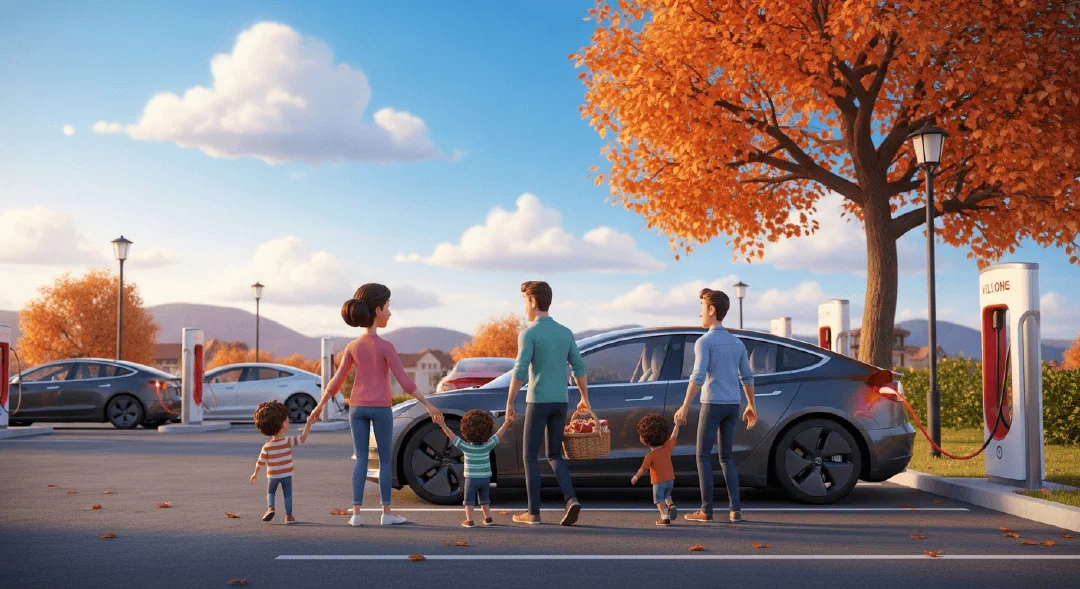
In 2012, Tesla started building something big — Supercharger stations all over the world.
Unlike home chargers, which take all night, a Supercharger can add 300 kilometers of range in just 30 minutes.
Tesla built thousands of these stations along highways, near restaurants, shopping centers, and cities in the United States, Europe, and China.
Now you can drive your Tesla across an entire continent and go wherever you want.
The Gigafactory
All these cars needed a lot of batteries.
In 2015, Tesla picked a special place — the desert in Nevada. Days there are scorching hot, nights freezing cold, and barely a blade of grass grows. But the desert has one big advantage: almost every day is bright and sunny.
In this desert, Tesla built a factory unlike any before. They called it the Gigafactory.
How big is it? Its floor area is about the same as 50 football fields put together. The entire roof is covered with solar panels, so sunlight alone can power the whole factory.
The most magical sight inside? Hundreds of giant robot arms working non-stop. They cut pieces, weld wires, and build batteries — turning raw materials, one second at a time, into shiny new battery cells.
Why build such a huge factory? Because the more batteries you make, and the better you get at making them, the cheaper each battery becomes. Cheaper batteries mean cheaper cars. Cheaper cars mean more families can afford to go electric.
Later, Tesla built more Gigafactories in Shanghai, Berlin, and Texas. Today, electric car parts pour out of these giant factories non-stop.
A Gift to the World
In 2014, Elon did something that shocked everyone.
All the technology Tesla had spent more than ten years developing — how to build batteries, how to make motors spin, how to write car software — had been protected by “patents.” Patents are like secret recipes that no other company can copy.
But one day, Elon said: “We’re making all of our patents public.”
Want to use them? Go ahead. Want to learn from them? Welcome.
Everyone was stunned. Why give away these carefully guarded secrets to other companies?
Elon’s answer was: “Our goal isn’t to be the company that sells the most cars. Our goal is to make every car on Earth electric. If only Tesla does this, it will take too long. The more people who join in, the faster the planet gets cleaner.”
It was like a chef who invented an amazing recipe deciding to publish it for the whole world — simply because they wanted everyone to be able to cook great food.
Little Surprises Inside the Car
Tesla cars have another thing grown-ups and kids both love — little secrets hidden inside.
Press a special combination on the screen, and magical things happen.
Turn on “Rainbow Road” mode, and the road on the screen suddenly becomes a rainbow bridge, like driving into a fairy tale.
There’s also a karaoke feature. Tesla has thousands of songs built in, with lyrics floating on the big screen like a music video. The whole family can sing together — suddenly, even traffic jams become fun.
There’s even a hidden “Sketchpad” app. Kids can draw dinosaurs, spaceships, or anything they want with their fingers. When your parents come back from shopping, a little artwork is waiting for them.
Want to spend a night camping in the mountains? Tesla has a “Camp Mode.” Press a button, and the car automatically adjusts the temperature, plays soft music, and locks the doors — turning into a tiny hotel on wheels.
Traditional car companies would never think of these things. For them, a car is just a car. Something you drive.
But Tesla believes a car should be fun, full of personality, and full of surprises. Just like a phone isn’t only for making calls, a car shouldn’t only be for getting around.
The World Really Changed
Stop for a moment. Think about everything that happened between 2003 and today.
In 2003, electric cars were a punchline. People said, “Those things will never work.”
Today? You see electric cars gliding silently past you on the road. Supercharger stations keep popping up next to highways. Even your grandparents might be thinking about going electric for their next car.
The Roadster was step one. The Model S was step two. The Model 3 was step three.
Tesla climbed step by step, pulling the whole world up with them.
And Elon’s dream isn’t over. In the next story, you’ll see Tesla take on something even bigger than making cars.
Did You Know?
- The Model S has a “Dog Mode.” If you leave your dog inside, the air conditioning stays on automatically, and the big screen displays a message to passersby: “My owner will be right back. The cabin is at 22°C.”
- Tesla cars have no engine in the front. The space where the engine would normally sit becomes a “front trunk” — big enough to stash a backpack or a few bags of groceries. Electric cars don’t need an engine taking up that space.
- The Gigafactory is one of the largest buildings in the world. You can see it clearly in photos taken from space.
Think About It!
- Elon wrote a plan in 2006 that wouldn’t be finished for ten years. Do you think a “long-term plan” is more helpful, or “figuring it out step by step”?
- Tesla shared its hard-earned secret technology with the whole world, hoping other carmakers would also make electric cars. Do you think “sharing” makes you weaker, or makes everyone stronger together?
- Tesla didn’t just build cars — they also built charging stations and battery factories. Why does solving one problem sometimes require solving many smaller problems around it?