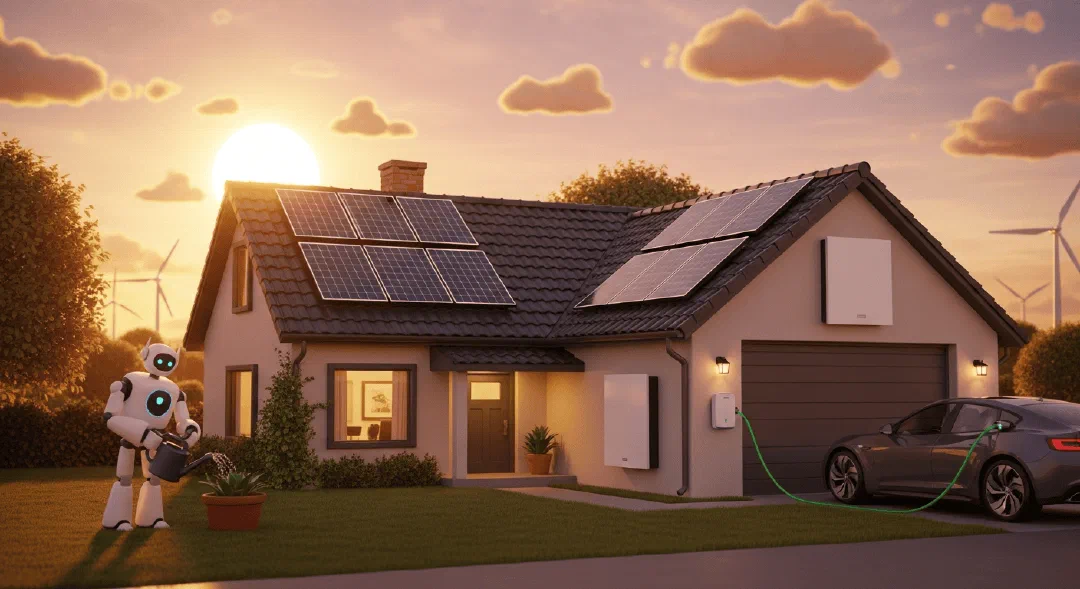
Elon Musk once said: “Tesla isn’t really a car company — it’s an energy company trying to solve climate change.” So what does that actually mean?
A Jaw-Dropping Announcement
In 2016, Elon Musk said something that stunned the whole world:
“Tesla isn’t trying to be a car company. What we’re really trying to do is solve climate change.”
Wait, what? A car company that doesn’t want to be a car company?
To understand what he meant, let’s look at a much bigger problem.
The World Runs on “Burning Things”
Think about it — why does the light in your bedroom turn on?
The answer is usually: because somewhere far away, a power plant is burning coal, natural gas, or oil to make heat, which boils water into steam, which spins a turbine, which makes electricity that travels through wires into your home.
Airplanes burn jet fuel. Cars burn gasoline. Factories burn all kinds of things.
All of this burning releases an invisible gas called carbon dioxide. It floats up into the sky and acts like a thick blanket, trapping the sun’s heat on Earth.
And slowly, the planet gets warmer. That’s what “climate change” is.
Elon thought: “Just making electric cars isn’t enough. Cars only use about a quarter of the world’s energy. If we really want to solve climate change, we have to help everything run on clean electricity.”
So Tesla began a much bigger mission: to build a whole new clean energy system for Earth.
Sunlight on the Roof
The first step was to capture energy from the sun.
In 2016, Tesla bought a company called SolarCity that specialized in rooftop solar panels. Solar panels are black rectangles that turn sunlight into electricity.
But Tesla had a bigger idea. They thought: “Why can’t the roof itself be a solar panel?”
In 2021, Tesla released the Solar Roof. The tiles look just like normal beautiful roof tiles — but every single one is actually a solar panel.
When the sun shines, your whole roof quietly generates electricity. From far away, it just looks like a lovely regular house.
That’s a clever idea — solving an environmental problem while making the house look better, not uglier.
What About When the Sun Goes Down?
There’s a problem, though.
During the day, solar panels make lots of electricity. But what about at night, when the sun has set?
The answer — store the extra electricity somewhere.
In 2015, Tesla released a product called the Powerwall. It’s a battery about the size of a refrigerator, mounted on your wall.
During the day, your solar panels generate electricity. Whatever you don’t use gets stored in the Powerwall. At night, your house uses that stored electricity.
The coolest part? If the power goes out on your street, your home keeps running. The TV stays on. The fridge stays cold. The lights keep shining.
For hundreds of years, electricity flowed one way — from huge power plants through wires into your home. Now, every home can make its own electricity and store it.
Imagine a neighborhood where every house has solar panels and a Powerwall. Even if the power lines across the whole neighborhood go down, nobody loses power.
Giant Batteries for Cities
But home batteries aren’t enough for everyone.
Tesla also makes giant batteries — the size of houses — for entire cities.
In Australia, Texas, and California, Tesla has built massive battery systems that help power whole regions.
They store electricity from wind farms and solar farms during the day. When the weather changes, or when lots of people need power at once, the batteries release it.
Slowly, the whole electric grid gets cleaner.
Cars That Drive Themselves
Every Tesla car has cameras, sensors, and a powerful computer inside. These devices watch the road constantly.
For years, Tesla has been using this data to teach cars how to drive themselves.
This is called “self-driving.” It means the car can drive without a human controlling it.
It might sound far away, but it’s closer than you think. Modern Teslas already have a feature called “Autopilot” that can steer, speed up, and slow down on highways without anyone touching the wheel. A human still needs to pay attention, but the car does most of the work.
The goal is to make cars so good at driving that accidents almost never happen — better than human drivers.
Why does this matter? Imagine grandparents who can’t drive anymore still being able to visit a park in a self-driving car. Imagine parents not having to grip the wheel during their commute. Imagine traffic accidents becoming rarer and rarer.
It sounds science-fiction. But remember — people said the same thing about electric cars just a few years ago.
Every time a Tesla drives, it’s learning. Millions of Teslas around the world are teaching their computers new road situations every single day. The computers get smarter and smarter.
This is “artificial intelligence” — computers learning to do things only humans used to be able to do.
A Robot That Stands Up
In 2023, Tesla did something even more surprising. They unveiled a robot.
Not a movie robot. A real one, with two arms and two legs, standing as tall as an adult.
Its name is Optimus.
Optimus can fold laundry. It can pick things up. It can open doors. Elon says that one day, you’ll be able to buy an Optimus for your home to help with chores. Factories can use them for dangerous or difficult work humans shouldn’t have to do.
Why would a car company build robots?
Because a self-driving car and a walking robot actually share the same “brain” — the same kind of thinking computer.
The car uses this brain to watch the road, recognize lanes, and read traffic lights. The robot uses it to see around the house and find what it needs to pick up. The bodies are different, but the way they think is the same.
The Big Picture
Step back and look at what Tesla is really building.
They’re building a world powered by clean, renewable energy. Here’s the plan:
Solar panels on roofs capture sunlight. Powerwalls and giant batteries store that energy for when the sun isn’t shining. Electric cars use the clean electricity to move people around. Robots and self-driving cars make life easier.
When all of these pieces work together, you get a world that runs on sunshine instead of burning things. The air becomes cleaner. Skies become bluer. The problem of climate change becomes smaller.
The Dream Isn’t Over
Tesla’s story isn’t finished. Today, electric cars are just becoming common. Solar roofs, home batteries, self-driving, and robots — each one is still early.
Ten years from now, they might all be as normal as smartphones are today. Every home might have them.
The future hasn’t been written yet. And the kid reading this story might be one of the people who helps write it.
Did You Know?
- In South Australia, a giant Tesla battery once saved an entire region. A power plant failed, but the big battery kicked in within milliseconds to fill the gap. People never even noticed the outage.
- Tesla’s factories have lots of robots working alongside human engineers. Some robots even have names.
- Every second, the sun sends more energy to Earth than all of humanity uses in an entire year. Tesla is working on turning that energy into electricity we can actually use.
Think About It!
- Imagine a neighborhood where every house has solar panels and a Powerwall. If one house has extra electricity, can they share with the neighbors? What would that neighborhood feel like?
- If cars could drive themselves one day, what would you do while riding? Would you read, study, or sleep?
- Self-driving cars and Optimus robots share the same “brain.” Can you think of two things that look totally different but are actually the same underneath?