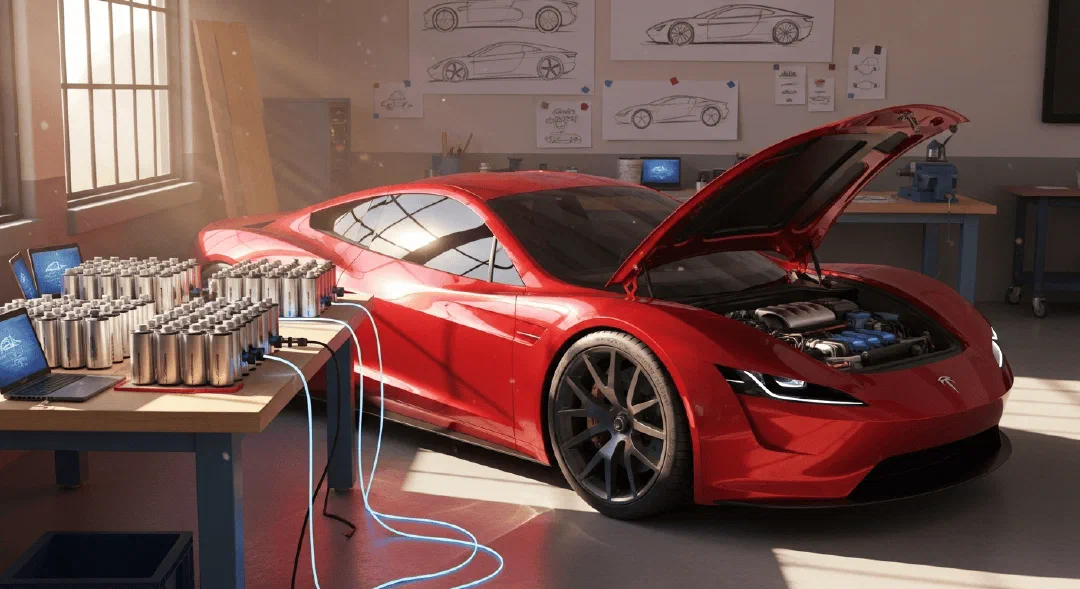
Everyone said electric cars were slow and boring — until two engineers and one big dreamer decided to build the most exciting car in the world.
Cars Back Then
Imagine traveling back to 2003.
Cars on the street roared loudly. Black smoke puffed out of their tailpipes. The smell of gasoline hung in the air everywhere.
Electric cars existed back then too. But they were slow, ugly, and could only drive a short distance. Charging took many hours. Nobody really wanted one.
Then two engineers decided to challenge what everybody thought.
Two Engineers Who Weren’t Afraid to Be Laughed At
They were Martin Eberhard and Marc Tarpenning.
Martin had worked in internet companies. Marc had written software. They weren’t car experts, but they loved cars — and they believed electric cars could become amazing.
Everyone told them: “Don’t be silly. Electric cars failed a hundred years ago. They’ll fail again.”
But Martin and Marc didn’t give up. They asked a different question: “What is the biggest problem with electric cars?”
The answer was simple — the battery.
Electric car batteries back then were heavy and weak. It was like trying to light up all the bulbs in your house for a whole night using just a few AA batteries. Impossible!
An Idea That Made People’s Eyes Pop
Then Martin and Marc had a wild idea: what if you strung together thousands of laptop batteries?
It sounded crazy. But if it worked, you could build an electric car that was fast and powerful.
On July 1, 2003, they started a company. They named it after a brilliant electricity inventor, Nikola Tesla, and called it Tesla.
Their goal was clear. They wouldn’t just build an electric car. They would build an electric car everyone would line up to buy — fast, beautiful, and unbelievably cool.
Joining the Dream
In 2004, a young inventor named Elon Musk decided to invest in Tesla.
Elon had just finished building PayPal, a company that lets people pay for things online. He believed the world needed clean energy, and that electric cars could help make Earth cleaner.
But Elon didn’t decide to invest on a whim. He went straight to Tesla’s office and climbed into a Roadster prototype to test-drive it himself.
When he got out, he said: “This is the best car I’ve ever driven.”
That same day, he decided to invest — and he joined the Tesla team personally. From that moment on, Martin, Marc, and Elon rolled up their sleeves together. They were going to do something the whole world said was impossible.
The Roadster Arrives
In 2006, Tesla unveiled its very first car: the Roadster.
Tesla didn’t design the whole car from scratch — that would’ve been too slow. They borrowed a chassis from a British sports car company called Lotus — a small sports car called the Lotus Elise. They ripped out the gasoline engine and replaced it with their own electric motor and thousands of laptop batteries.
A British body + a California motor + Japanese batteries — that’s how the Roadster came together.
On a single charge, it could drive 385 kilometers — enough to go from the city to the beach and back. Sleek curves, shiny red paint — wherever it rolled, heads turned.
For the first time, an electric car didn’t look boring. It looked like the future.
Driving It Felt Like a Lightning Bolt
But the most surprising thing about the Roadster wasn’t how it looked. It was how it felt to drive.
It could go from zero to 96 km/h in just 3.9 seconds — faster than most gasoline sports cars.
But the really special part wasn’t “how fast” — it was “how the speed arrived.”
A gasoline sports car has to shift through several gears when accelerating, bumping and pausing between each one. The Roadster had just one gear — step on the pedal, and all of the power blasted out at once.
Many people who test-drove a Roadster for the first time said: “It felt like an invisible force whooshed me back into my seat!”
And the Roadster was incredibly quiet. No roaring engine. Just the soft whisper of tires on the road — like a breeze flying past you.
So quiet that it actually became a problem — people walking by the street often didn’t hear the car coming. Later, many countries made a rule: at low speeds, electric cars have to make a small artificial sound, so they don’t startle anyone.
A Car That Gets Smarter by Itself
Tesla quietly did something else that nobody else in the car world had ever done — they made cars that could connect to the internet and download new features, just like a phone.
Your phone probably pops up a “software update” notification every now and then. Tesla cars do the same thing.
Something the car couldn’t do yesterday, it might have learned to do by the next morning — maybe a new map feature, maybe a new game on the screen.
In the car world, nobody had ever even thought of this. A car that actually gets smarter over time.
The Christmas Eve Miracle
The Roadster was amazing, but Tesla ran into big trouble.
First, the Roadster was very expensive. Only a few people could afford one. Second, there were almost no fast charging stations yet. Drive too far and you might get stuck.
Worse still, in 2008, the whole world was hit by a huge economic storm. Many companies couldn’t survive. Tesla sank into a very deep crisis.
Then came December 24, 2008 — Christmas Eve.
That day, Tesla was almost completely out of money. In a few more days, the company would really shut down.
From morning until night, Elon made phone call after phone call, meeting investors, begging anyone who might help. He also poured most of his own savings into the company.
In the final few hours of Christmas Eve, he finally closed a big enough investment.
Tesla survived.
Elon often says: “Even if I fall, I will keep moving forward.”
Showing the World
In 2010, Tesla delivered its very first Roadster to a customer.
Over the next few years, they sold about 2,500 of them. Not a huge number — but enough to prove something important:
Electric cars can be cool, fast, and beautiful. And people really do want to drive them.
A Red Sports Car That Flew Into Space
The Tesla story has one more twist that nobody saw coming.
In 2018, Elon decided to do something both very cool and a little crazy — he strapped his own red Roadster onto a giant rocket and launched it into outer space.
Why would anyone do that? Elon said: “Launching a real car into space is way more fun than launching a regular satellite.”
In the driver’s seat sat a dummy wearing a full spacesuit. Elon gave him a name — Starman.
Inside the car, a speaker played one song on a loop — David Bowie’s “Space Oddity,” an old song about an astronaut who gets lost in space.
And so Starman and that red Roadster flew away.
Today, they’re still orbiting the sun. They’ve passed Mars’ orbit several times already. Elon says the car will keep flying through space for millions of years.
Farther than any car on Earth will ever travel.
The Roadster Was Just the Beginning
While Starman keeps drifting through space, back on Earth Tesla was getting ready for its next step.
The Roadster was like the first step of a very, very long staircase. Bigger, more exciting dreams were still waiting for Tesla to climb toward.
Did You Know?
- The company’s name, Tesla, comes from an inventor named Nikola Tesla who lived over 100 years ago. He invented “alternating current” — the kind of electricity that flows into your home today and lights up your lamps.
- The Roadster had roughly 6,800 laptop batteries inside, all wired together to push the whole car.
- Starman’s Roadster has a little plaque on it that reads “Don’t Panic!” — a quote from a famous science fiction novel called The Hitchhiker’s Guide to the Galaxy.
Think About It!
- Tesla’s first car was expensive, and only a few people could buy one. Why does it sometimes help to start with a “small expensive thing” before you can reach a “cheap big goal”?
- Tesla didn’t invent the battery or the electric car, but they combined existing ideas in a new way. Can you think of things around you that are actually “new combinations of old things”?
- If you had the chance to design a car of the future, what would it look like? What amazing technology would it use?